Stronger Than Yesterday Laser Cut File
I recently received a brief from a client launching a boutique wellness brand focused on mental resilience and personal growth. They needed a central visual element for their launch campaign—a piece that could anchor their social media graphics, serve as the focal point for packaging inserts, and potentially translate into physical merchandise like laser-cut wall decor. The mood board was heavy on earth tones, clean lines, and motivational typography. That is when I evaluated the Stronger Than Yesterday Laser Cut File. As a designer who deals with branding, marketing visuals, and digital assets daily, my first instinct is not to ask "does it look cool?" but rather "does this solve the problem without creating new ones?"
First Impressions: Mood and Visual Weight
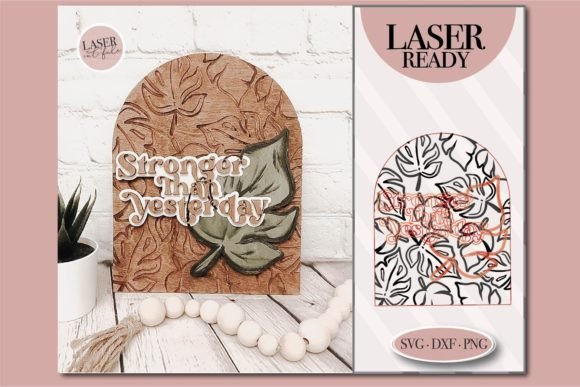
The moment I opened the file, the design’s intent was clear. It carries a powerful and motivational quote—Stronger than yesterday—which immediately signals its utility in the self-improvement, fitness, or coaching niches. Visually, the asset possesses a strong geometric structure typical of high-quality laser cutting templates. The negative space is handled with precision, which is critical when dealing with intricate cut lines. Unlike standard vector illustrations that rely solely on color, this graphic design asset relies on silhouette and form. This gives it a timeless quality that fits well within modern design aesthetics, avoiding trends that might date the project quickly.
The visual weight is balanced, making it suitable for large layout areas where it can breathe. It creates a sense of strength and stability, which aligns perfectly with the brand narrative of overcoming challenges. For a handmade business or a small business branding effort, this kind of emotional resonance is invaluable. It doesn’t just decorate; it communicates a value proposition instantly.
Performance in Real Design Situations
In my workflow, versatility is key. I tested this asset across several common commercial design scenarios to see how it holds up. When used as part of a brand identity, it serves as an excellent secondary logo mark or icon. It works particularly well in packaging design, where it can be die-cut into cardboard boxes or used as a sticker design element that adds tactile interest. The clean lines ensure that even at smaller sizes, such as on product labels or sticker design sheets, the shape remains legible.
For marketing visuals, the asset shines. I placed it on various backgrounds to simulate social media graphics for Instagram posts and Pinterest pins. Its bold outline makes it pop against both light and dark backdrops, provided the contrast is managed correctly. It also translates beautifully into printable design formats. Clients often request print-on-demand products, and this file is ideal for t-shirt design, mugs, and tote bags. The simplicity of the cut pattern means it reproduces well on different materials, from fabric to ceramic.
Furthermore, for creators using tools like Cricut or Silhouette, this SUV design (assuming SVG format) is ready for immediate use. It eliminates the need for tracing or redrawing, saving valuable production time. In the context of a Cricut project or a sublimation design, the precision of the cuts ensures a professional finish that enhances the perceived value of the final product.
Where the Asset Excels
- Hero Graphics: Use it as the main visual in email headers or website banners for web design projects related to motivation or lifestyle.
- Packaging Details: Incorporate it into unboxing experiences as a laser-cut insert or hang tag, adding a premium feel to Etsy product listings.
- Editorial Design: It can serve as a decorative accent in magazines or blogs, breaking up text blocks while reinforcing thematic content.
- Merchandise Mockups: Place it on real mockups to visualize how it looks on apparel or home goods, helping clients make informed purchasing decisions.
Areas Requiring Caution
No asset is perfect for every scenario. While the Stronger Than Yesterday Laser Cut File is robust, there are limitations. Avoid placing it in crowded layouts where visual hierarchy becomes confused. If the surrounding elements are too busy, the intricate cut details may get lost, reducing its impact.
Additionally, be mindful of scale. At very small sizes, fine details in the cut lines may disappear or become difficult to reproduce accurately, especially in low-resolution print environments. It is less suitable for minimalist branding projects that require extremely subtle, thin-line art, as this asset has a bolder presence. Also, ensure it does not clash with complex backgrounds; simple, solid, or softly textured backgrounds work best to maintain visual trust and clarity.
Technical and Practical Designer Notes
Before integrating this asset into a client project, a thorough technical review is essential. First, test it in black and white. This helps assess the integrity of the design independent of color choices. Check the contrast on both light and dark backgrounds to ensure visibility and readability.
Preview the asset at various sizes, from thumbnail dimensions to large-format prints. Inspect the file formats carefully. If you are using it for laser cutting, confirm the SVG or vector editability. Ensure all paths are closed and nodes are optimized to prevent cutting errors. If a PNG design version is included, check the transparency and resolution to ensure it is crisp for digital use.
Consider how the asset interacts with other typographic elements. Compare it with serif font, sans serif font, script font, handwritten font, and display font styles to find the best pairing. Often, a clean sans-serif font complements the geometric nature of laser cut files, maintaining a cohesive design bundle aesthetic.
Finally, and most importantly, confirm the commercial license. Using design assets for client work requires proper rights. Verify that the commercial license permits usage in end-products sold to customers, whether physical or digital. This protects both you and your client from legal issues.
Conclusion
The Stronger Than Yesterday Laser Cut File is more than just a decorative element; it is a strategic tool for designers working in the motivation, wellness, and handmade sectors. Its ability to convey strength and resilience through clean, precise geometry makes it a versatile addition to any creative marketplace portfolio. Whether used for logo design, product mockup presentations, or direct-to-consumer sales, it adds a layer of professionalism and emotional appeal that resonates with audiences. By paying attention to contrast, scale, and licensing, designers can leverage this asset to create polished, impactful results that truly support their clients' goals.